- drmanish@mayomhospital.com
- +91 9999469769 , 01244111880
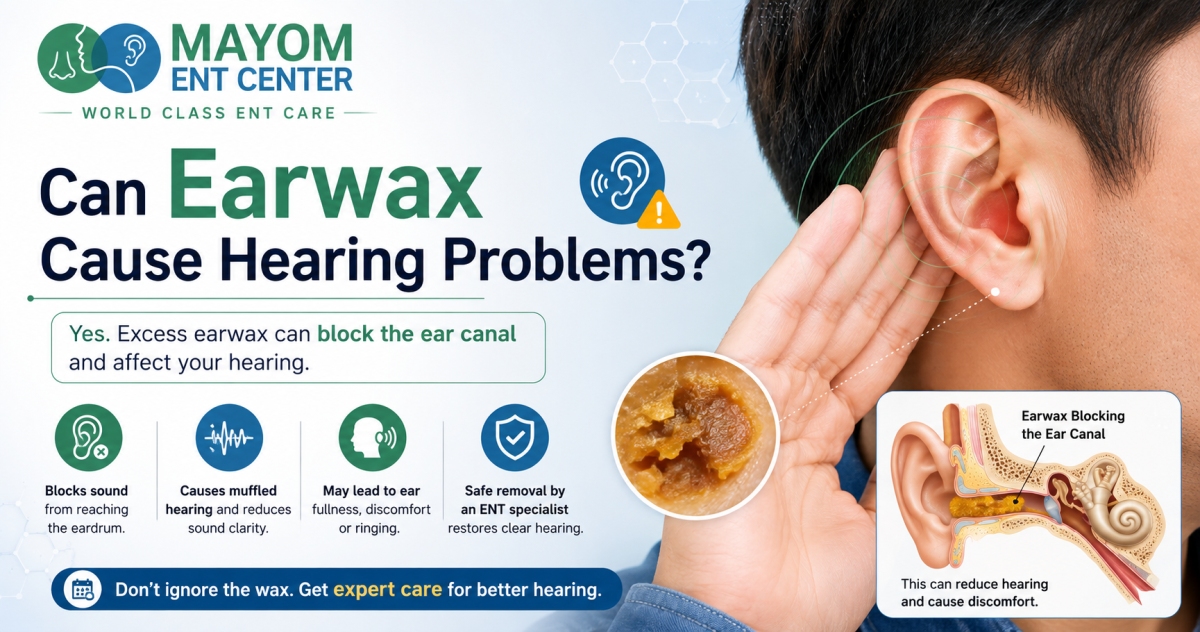
Yes. Sometimes that strange feeling of having one ear “switched off” has nothing to do with ageing, nerve damage, or a serious ear disease. It may simply be earwax.
Sounds too ordinary, right?
But here's the thing: earwax can build up quietly. It can harden. It can press against the ear canal until sounds start becoming muffled, distant, almost as if you're listening to someone through a closed door.
That doesn't mean every case of hearing difficulty is caused by wax. Far from it. But when hearing changes suddenly—particularly in one ear—getting an expert opinion from ENT GURGAON can save you from guessing and treating the wrong problem.
Earwax, medically called cerumen, isn't something your ears need to get rid of completely. Your ears actually make it for a reason.
It traps dust. It keeps the ear canal lubricated. It offers some protection against bacteria and irritation.
The trouble starts when too much of it accumulates.
Normally, old wax gradually moves towards the outer ear and falls away on its own. Sometimes, though, the process gets disrupted. Frequent use of earbuds, inserting cotton buds into the ear, narrow ear canals, hearing aids, or simply producing more wax than usual can push it deeper inside.
And then? Blocked.
Think about the ear canal as a small tunnel carrying sound towards the eardrum. Now imagine someone placing a thick plug halfway down that tunnel.
Sound can't travel normally.
Impacted earwax can cause conductive hearing loss, meaning sound has difficulty reaching the eardrum efficiently. You may notice that voices sound dull, television volume keeps creeping upward, or conversations become frustratingly unclear.
Some people also experience a feeling of fullness, ringing in the ear, itching, or even mild dizziness.
That last one catches people off guard.
They assume something is seriously wrong with their balance system when the real culprit may be a compact mass of stubborn wax sitting inside the ear canal.
This is where things get interesting.
People often use cotton buds because they believe they're cleaning their ears. In reality, they can behave more like tiny wax shovels.
Instead of removing the wax, the bud may push it deeper towards the eardrum. One day everything seems fine. A few days later, hearing suddenly feels blocked.
And the cotton bud gets blamed? Usually not.
The ear does not need aggressive cleaning. If wax is causing symptoms, an ENT doctor can examine the ear and decide whether removal is actually necessary.
Here's the distinction worth remembering: not every hearing problem is earwax.
If hearing loss develops gradually, keeps returning, affects both ears, or comes with tinnitus, dizziness, ear discharge, severe pain, or other symptoms, don't assume wax is responsible.
Sudden hearing loss deserves particularly urgent medical evaluation because certain forms of inner-ear hearing loss need treatment quickly.
This is where a specialist such as Dr Manish Prakash can help determine whether you're dealing with impacted wax, an ear infection, eardrum damage, or a deeper hearing problem.
Guessing isn't treatment.
Treatment is usually straightforward when wax is genuinely the cause.
A doctor may examine the ear using an otoscope and, depending on the situation, remove the wax through safe clinical methods such as microsuction or specialised instruments. The approach depends on the amount of wax, its consistency, the condition of the eardrum, and the patient's medical history.
Don't pour random oils or unprescribed drops into an ear that hurts or has discharge. And definitely don't poke around with pins, keys, hair clips, or anything else that happens to be within arm's reach.
Your ear isn't a drawer that needs decluttering.
That's an important clue.
If the ear has been properly cleared and hearing remains reduced, the problem may lie elsewhere. An audiological assessment can identify whether there is conductive, sensorineural, or mixed hearing loss.
Depending on the diagnosis, treatment might involve medication, hearing rehabilitation, or a hearing device. Patients who require amplification may benefit from consultation with a Hearing Aid Specialist in Gurgaon, particularly when selecting, fitting, and adjusting a hearing aid to suit their specific hearing profile.
For more complex ear conditions, visiting the Best Ear Hospital in Gurgaon can provide access to ENT evaluation, audiology, diagnostic testing, and specialised treatment under one roof.
Keep it simple.
Don't insert cotton buds deep into your ears. Avoid repeatedly scratching the ear canal. If you use hearing aids or earbuds regularly, maintain them properly and pay attention to recurring blockage.
And if your ears repeatedly feel plugged, get them examined rather than repeatedly trying to clean them yourself.
Sometimes the smartest thing you can do for your ears is nothing at all.
If hearing difficulty persists, professional Hearing loss treatment in Gurgaon can identify the real cause and guide you towards appropriate care.
Earwax is normal. Ignoring unexplained hearing loss isn't.