- drmanish@mayomhospital.com
- +91 9999469769 , 01244111880
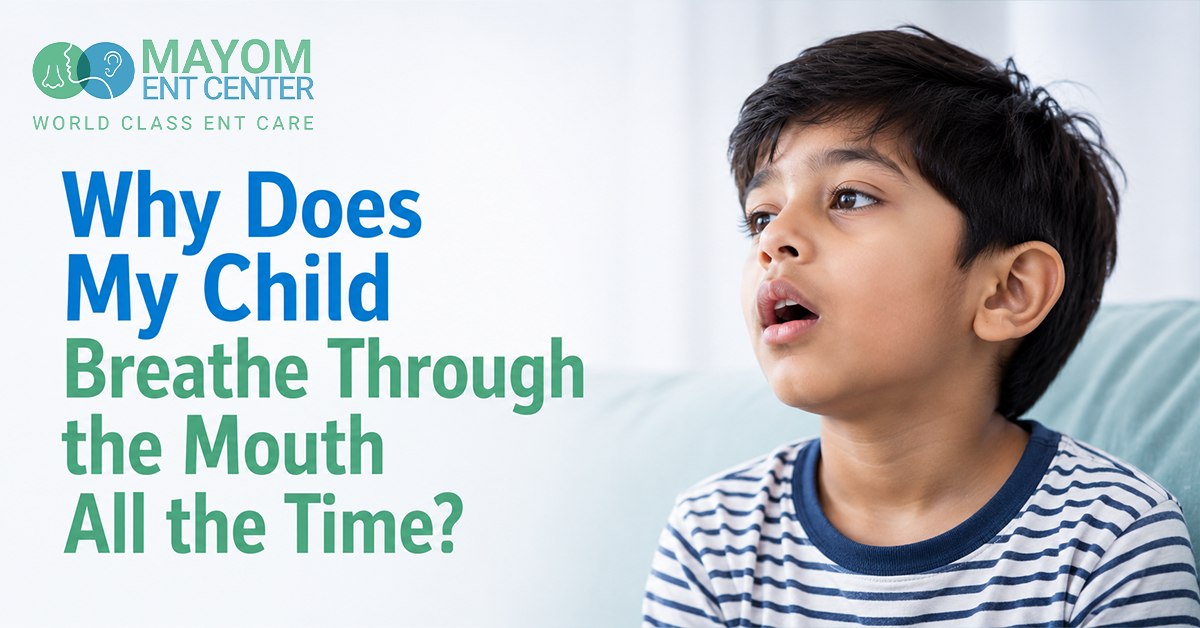
You notice it during sleep first.
The mouth hangs open. The breathing sounds heavier than usual. Sometimes there's even a soft snore coming from a child who seems far too young to snore at all.
Parents often shrug it off. Kids do strange things, right?
Not always.
Mouth breathing isn't just a habit. In many cases, it's your child's way of coping with an airway problem that prevents normal breathing through the nose. And when it continues for months—or years—it can affect sleep, growth, concentration, and overall health.
Which brings us to the real question: why is it happening?
One of the most common reasons is enlarged adenoids. These are small patches of tissue located behind the nose that help fight infections during childhood. Sounds harmless. Until they become swollen.
Imagine trying to breathe through a straw that's been pinched halfway shut. That's what many children experience every night when enlarged adenoids block airflow through the nasal passages. Instead of breathing through the nose, the body takes the easier route—the mouth.
Simple.
But here's the thing. Mouth breathing rarely travels alone.
Children with enlarged adenoids often snore loudly, sleep restlessly, wake up tired, struggle to concentrate in school, or constantly seem to have a blocked nose even when they don't have a cold. Some develop a nasal-sounding voice. Others become surprisingly irritable because poor sleep quietly chips away at their energy.
Parents don't always connect these dots.
A child who seems "lazy" in class might simply be exhausted. A child who appears distracted may have spent the entire night struggling to breathe properly.
That's where proper evaluation becomes important.
An experienced ENT Specialist in Gurgaon can identify whether adenoids, allergies, chronic sinus problems, enlarged tonsils, or another airway issue is responsible. Specialists at ENT GURGAON, including Dr Manish Prakash, frequently assess children with persistent mouth breathing and recurring nasal blockage.
Sometimes the culprit isn't adenoids at all.
Allergies can trigger continuous swelling inside the nose. Dust mites hide in mattresses. Pet dander is floating around the house. Even seasonal pollen. Tiny irritants. Big consequences.
A child may spend months breathing through the mouth simply because the nasal passages remain inflamed day after day.
Then there are structural issues. A deviated nasal septum. Chronic sinus inflammation. Enlarged tonsils. Less common, yes, but certainly not rare.
Which is why guessing doesn't help.
A proper examination tells the real story.
Many parents ask whether mouth breathing can actually cause problems if their child otherwise seems healthy. The answer is yes.
Over time, chronic mouth breathing may contribute to poor sleep quality, dry mouth, recurrent throat infections, dental issues, and even changes in facial growth patterns. Some specialists refer to this as "adenoid facies"—a long, narrow face with an open-mouth posture that develops gradually over years.
Nobody notices it overnight.
That's the problem.
The changes happen slowly, like watching a plant grow. You don't see it day by day. Then one morning, you look closer and realise things have changed.
Thankfully, treatment is often straightforward.
Depending on the cause, options may include allergy management, medications to reduce nasal inflammation, treatment of infections, or specialised Child Adenoid Treatment in Gurgaon. In cases where enlarged adenoids significantly obstruct breathing or affect sleep, a minor surgical procedure may be recommended.
The goal isn't just to stop mouth breathing.
It's helping a child sleep deeply, breathe comfortably, focus better, and feel healthier overall.
A better night. A better day.
If your child constantly breathes through the mouth, snores, struggles with nasal blockage, or seems unusually tired despite getting enough hours of sleep, don't assume they'll simply outgrow it. An evaluation by a Pediatric ENT Doctor in Gurgaon can uncover the cause before it begins affecting long-term health.
Sometimes a child's open mouth isn't a habit.
It's a signal.
And it's worth listening to.