- drmanish@mayomhospital.com
- +91 9999469769 , 01244111880
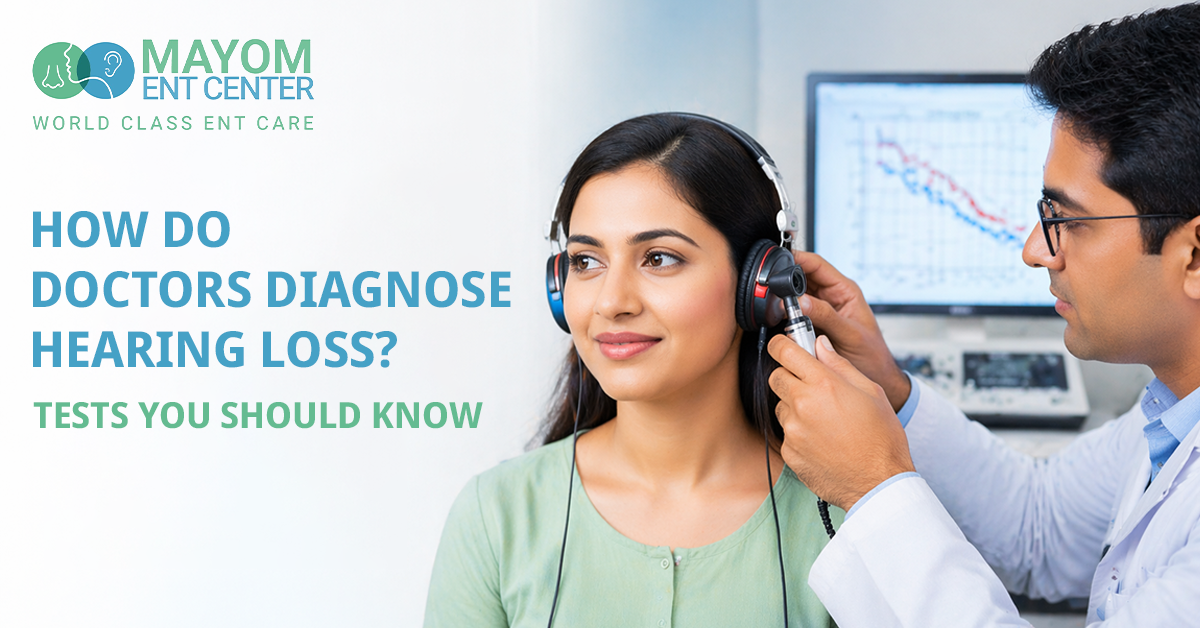
Hearing loss rarely arrives with dramatic warning signs. More often, it sneaks in quietly—people begin turning the TV volume up, asking others to repeat themselves, or struggling to follow conversations in noisy rooms. If that sounds familiar, the next step is simple: get evaluated by an ENT Specialist in Gurgaon before the issue worsens.
The good news? Diagnosing hearing loss today is far more precise than many people realise. At advanced centres for ENT Gurgaon, specialists like Dr Manish Prakash use a combination of clinical exams and hearing tests to pinpoint not just whether hearing loss exists, but why it’s happening.
Let’s break down the tests doctors commonly use.
First comes the basic—but crucial—step: examining the ear.
Your ENT doctor checks the ear canal and eardrum using an otoscope to rule out visible causes such as:
Sometimes the “hearing loss” turns out to be a wax plug. Not glamorous, but far better than nerve damage.
This is the most common hearing test.
You’ll wear headphones and listen to tones of different pitches and volumes. Every time you hear a sound, you respond. Simple enough—but incredibly useful.
This test helps determine:
It forms the backbone of most hearing loss treatment plans in Gurgaon.
Hearing tones is one thing. Understanding speech? That’s another.
Speech audiometry checks how well you can hear and repeat spoken words at different volumes. Why does this matter? Some patients hear sounds but still struggle to understand speech clearly.
That distinction helps ENT doctors tailor treatment more accurately.
Ever feel ear fullness or pressure? Tympanometry helps evaluate that.
This test checks how well your eardrum moves in response to pressure changes. It is useful for identifying:
Quick, painless, and surprisingly informative.
This test is often used for children, newborns, or patients who can’t respond reliably during standard hearing tests.
A small probe is placed in the ear canal to measure how the inner ear responds to sound. It helps detect cochlear (inner ear) damage early.
When doctors suspect nerve-related hearing loss, they may recommend ABR testing.
Electrodes are placed on the head to measure how the hearing nerves and the brain respond to sound. It’s especially useful for:
Not all hearing loss is the same. Some cases are caused by infection. Others by nerve damage. Some improve with medication; some need hearing aids; some may require surgery.
That’s why guessing is risky.
Proper testing by an experienced ENT Specialist in Gurgaon ensures you receive the right hearing loss treatment in Gurgaon not just temporary symptom relief.
Hearing loss diagnosis isn’t about one test and one answer. It’s a layered process, designed to uncover the exact reason your hearing has changed. And honestly? The earlier you get tested, the better the chances of effective treatment.
If you’re noticing signs of hearing difficulty, don’t shrug it off as “just getting older.” Book an evaluation with a trusted ENT Gurgaon expert like Dr Manish Prakash. Because hearing well shouldn’t be optional—and neither should getting it checked.