- drmanish@mayomhospital.com
- +91 9999469769 , 01244111880
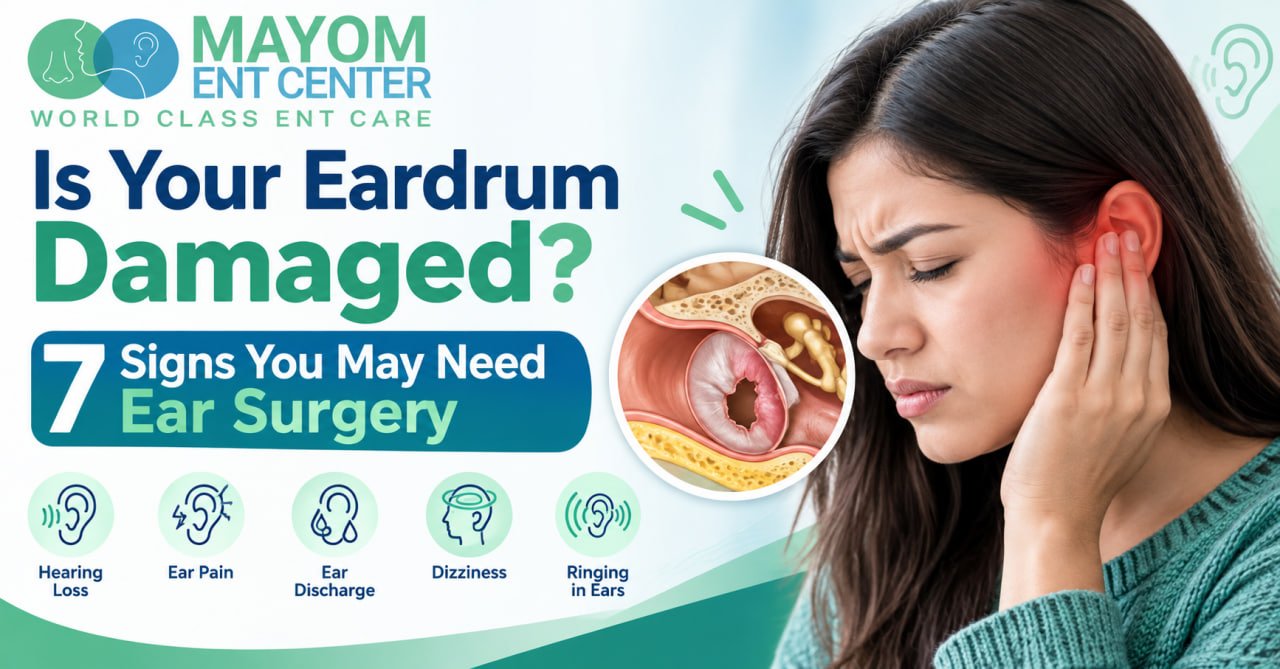
Your ear hurts. Sounds seem strangely distant. Maybe there’s a little discharge, or a persistent ringing that wasn’t there yesterday.
You wait.
That’s where trouble can begin.
An injured eardrum doesn’t always announce itself with dramatic pain. Sometimes the signs are annoyingly subtle—a muffled conversation, repeated ear infections, or the feeling that one ear is permanently “blocked.” And while many small eardrum perforations heal on their own, some don’t. When the damage persists, surgery may be needed to protect hearing and prevent repeated infections.
For patients looking for specialised care in ENT GURGAON, understanding these warning signs can make the difference between simple monitoring and more complicated treatment. Dr Manish Prakash provides evaluation and treatment for a range of ear and hearing conditions, including cases where surgical intervention may be appropriate.
The eardrum, or tympanic membrane, is remarkably thin. It can tear because of a severe ear infection, an accidental injury, inserting cotton buds or other objects into the ear, exposure to an explosive sound, or sudden pressure changes during flying or diving.
And yes, even something as ordinary as trying to “clean” a stubborn ear can cause damage.
Once perforated, the eardrum may heal naturally. But not every perforation closes.
A perforated eardrum can reduce the transmission of sound into the middle ear. If your hearing remains muffled weeks after an injury or infection, it deserves proper examination rather than endless waiting.
An audiometry test can help determine how much hearing has been affected.
Persistent or recurring fluid or pus coming from the ear is a red flag. It may indicate that the perforation has allowed bacteria to repeatedly enter the middle ear.
That cycle needs breaking.
If your ear infection keeps returning despite appropriate medication, an underlying eardrum perforation or middle-ear problem could be responsible. A specialist can examine the ear under magnification and determine whether surgical repair is necessary.
Small perforations frequently close naturally, but a larger or long-standing hole may remain open. When healing stalls, an Ear Surgery Specialist in Gurgaon may recommend repair rather than continuing to wait indefinitely.
Tinnitus can accompany eardrum damage. It doesn't automatically mean you need surgery—but persistent ringing combined with hearing loss or discharge warrants a thorough ENT assessment.
Your ear isn't only about hearing. The deeper structures of the ear help control balance. Significant dizziness after ear trauma or infection shouldn't be brushed aside, particularly when accompanied by hearing changes.
A perforated eardrum itself may not always hurt. But recurring pain, pressure, discharge, and hearing changes can point toward ongoing middle-ear disease that requires more than temporary medication.
No.
That's an important distinction.
Many perforations heal without an operation when the ear is kept dry and the underlying infection is treated appropriately. Surgery is generally considered when the perforation persists, infections keep returning, hearing is affected, or there is additional middle-ear damage.
Depending on the problem, procedures may include tympanoplasty or other forms of ear surgery designed to close the perforation and, when necessary, repair the tiny hearing bones.
Modern Micro Ear Surgery in Gurgaon uses specialised magnification and delicate instruments to treat structures that are only a few millimetres in size. The goal isn't simply to “close a hole.” The surgeon also considers the condition of the middle ear, hearing mechanism, and surrounding structures.
That precision matters.
Don't put oil, drops, cotton buds, or homemade remedies into the ear unless a doctor has specifically advised them. Keep the ear dry, avoid forceful nose blowing, and get it examined.
A timely consultation with Dr Manish Prakash in ENT GURGAON can help determine whether the eardrum is likely to heal naturally or whether specialist intervention is appropriate.
Your hearing is worth protecting.
And when an ear problem keeps coming back, “I'll wait a little longer” isn't always the safest plan.