- drmanish@mayomhospital.com
- +91 9999469769 , 01244111880
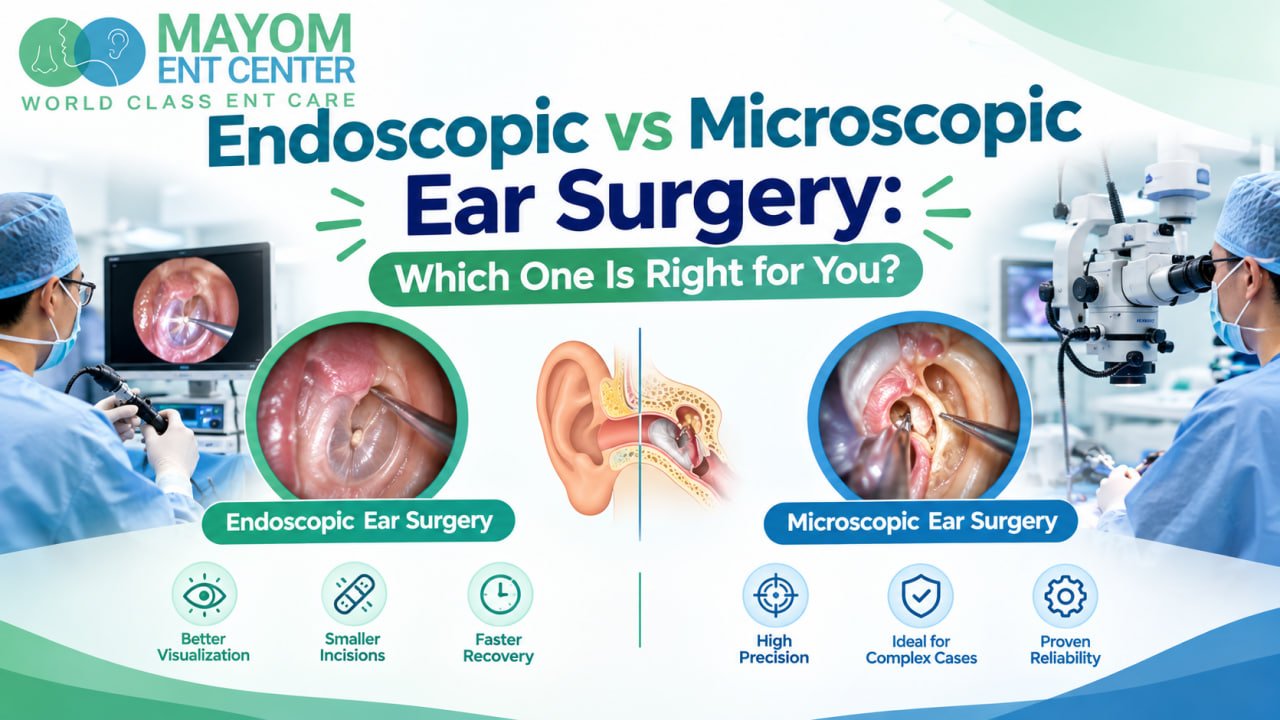
Ear surgery sounds intimidating. The word “surgery” alone can make people imagine long hospital stays, large incisions, and weeks of discomfort.
But ear surgery has changed.
Today, ENT surgeons can use highly specialised techniques to treat conditions inside the ear, and two approaches you may hear about are endoscopic ear surgery and microscopic ear surgery. So, which one is better? Which one should you choose?
There isn't a universal answer.
The right technique depends on the ear problem, its location, its extent, your hearing status, and the surgeon's assessment. A consultation with an experienced ENT specialist is the place to start.
Endoscopic ear surgery uses a thin, angled camera called an endoscope to provide a magnified view of structures inside the ear. Instead of looking only through a microscope from outside, the surgeon can use the endoscope to see around corners and into areas that may otherwise be difficult to visualise.
That can be particularly useful for selected middle-ear conditions and certain types of ear disease.
The biggest advantage?
Visibility.
An endoscope can offer a wider field of view, sometimes allowing the surgeon to identify disease hidden behind folds or structures that aren't easily visible through a straight microscopic view.
This approach can also allow surgery through the ear canal in selected cases, potentially reducing the need for larger external incisions.
Microscopic ear surgery has been a cornerstone of modern ear surgery for decades. It uses a surgical microscope that provides excellent magnification and depth perception, allowing the surgeon to work with remarkable precision.
It remains extremely valuable.
Procedures involving complex reconstruction, extensive disease, or areas requiring two-handed surgical work may be better suited to a microscopic approach. Depending on the condition, microscopic techniques may be used for procedures such as tympanoplasty, mastoid surgery, and other forms of ear reconstruction.
So no, microscopic surgery isn't “old-fashioned.”
Far from it.
Think of it this way: an endoscope can behave somewhat like a tiny periscope, allowing the surgeon to look into spaces that are difficult to see directly. A microscope, meanwhile, provides superb magnification and depth perception while giving the surgeon a stable operating view.
Neither technique automatically wins.
For a small, well-localised disease, endoscopic ear surgery may offer an excellent minimally invasive option. For extensive disease or complicated reconstruction, microscopic surgery may provide advantages.
Sometimes surgeons even use both techniques during the same procedure—choosing the tool that gives the safest and clearest view at each stage.
That's surgical judgment, not a competition between gadgets.
Depending on the diagnosis, endoscopic surgery may be considered for selected cases involving:
However, suitability must be determined individually. Not every patient is a candidate for an endoscopic approach.
If you're searching for the Best Endoscopic Ear Surgery in Gurgaon, don't choose a surgeon simply because a particular technique sounds newer. Ask what approach is appropriate for your ear and why.
Microscopic surgery can be especially useful when the surgeon needs excellent depth perception, extensive access, or both hands for delicate reconstruction.
Patients with advanced ear disease, complicated mastoid involvement, or certain hearing reconstruction requirements may benefit from this approach.
This is where experience matters.
A good ear surgeon doesn't force every patient into the same technique. The disease dictates the operation.
Recovery varies according to the procedure rather than simply whether an endoscope or microscope was used. A smaller endoscopic procedure may have a relatively straightforward recovery, but more extensive surgery—regardless of technique—can require more healing time.
Your surgeon will explain restrictions regarding water exposure, flying, exercise, hearing, and follow-up.
And yes, follow-up matters. A technically successful operation still needs proper aftercare.
If you are considering ear surgery, look beyond the label “endoscopic” or “microscopic.” Ask about the diagnosis, surgical objective, expected hearing outcome, possible risks, and why a particular approach has been recommended.
An experienced ENT surgeon such as Dr Manish Prakash can evaluate the ear carefully and determine whether endoscopic, microscopic, or a combined technique is most appropriate.
At ENT GURGAON, the focus should always be on treating the disease safely—not simply choosing the newest-sounding technology.
Endoscopic ear surgery and microscopic ear surgery are both valuable techniques.
One isn't automatically better than the other.
The best operation is the one that gives the surgeon the safest access, clearest view, and greatest ability to treat your specific ear problem while preserving or improving hearing whenever possible.
If you're exploring Best Endoscopic Ear Surgery in Gurgaon or Micro Ear Surgery in Gurgaon, start with an accurate diagnosis and a detailed discussion with your ENT surgeon. The technology matters.
But the surgeon's judgment matters more.