- drmanish@mayomhospital.com
- +91 9999469769 , 01244111880
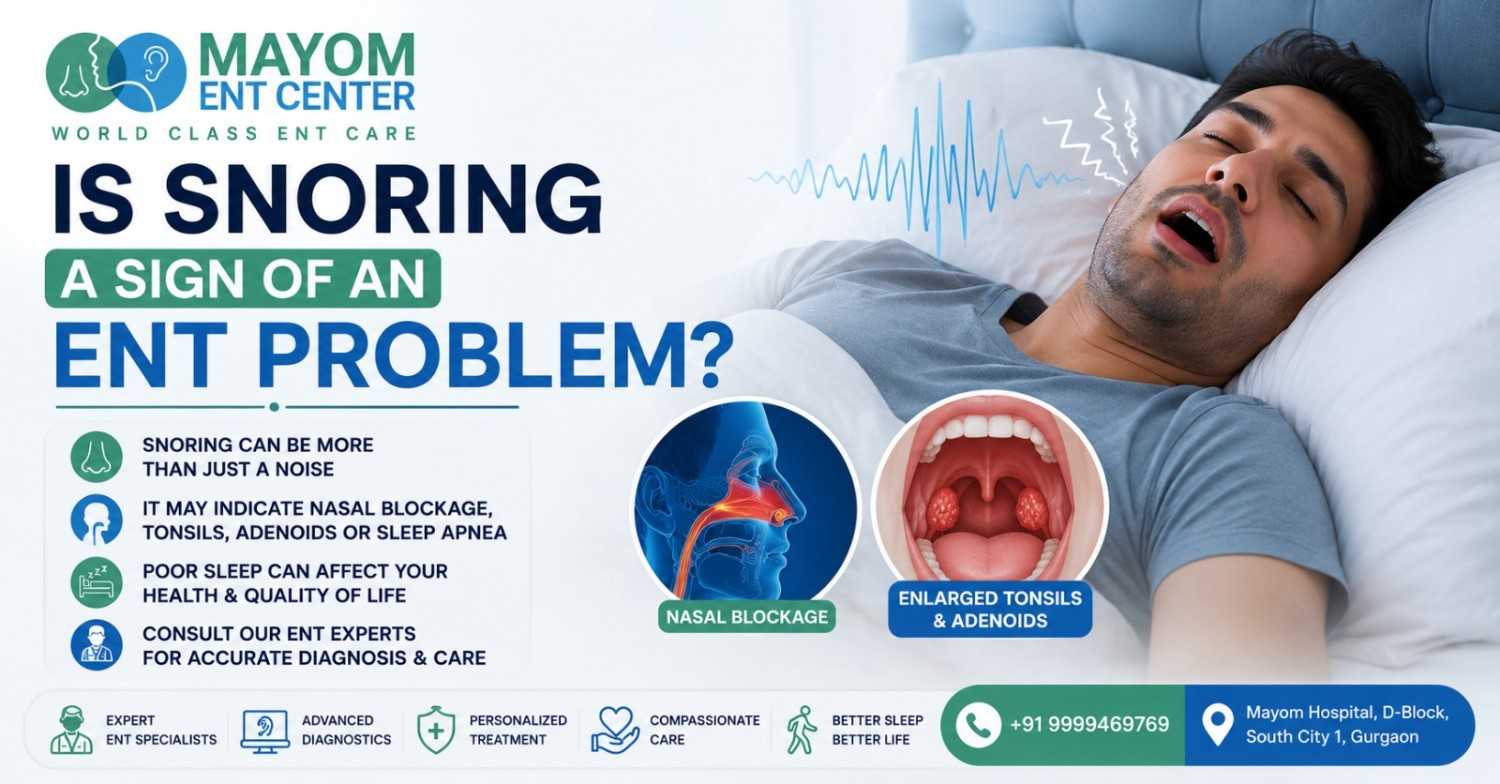
A lot of people laugh at snoring.
They joke about it. They blame a soft pillow, a tiring day at work, or the extra serving of biryani at dinner. Someone gets nudged in the middle of the night. Someone else gets banished to the sofa. Life moves on.
Until it doesn't.
Because sometimes snoring isn't just noise. It's a signal.
A surprisingly loud one.
Walk into any ENT GURGAON clinic, and you'll hear a familiar story: "Doctor, my family says I snore so loudly they can hear me from the next room." The patient usually shrugs while saying it. The spouse doesn't. They're exhausted. The children are annoyed. And beneath all the humour sits a question worth asking—what if the snoring is actually coming from an underlying ENT problem?
Let's start with the basics.
Snoring happens when air struggles to move freely through the nose or throat during sleep. The tissues vibrate. The vibration creates sound. Sometimes it's a gentle rumble. Sometimes it sounds like a diesel engine trying to start on a cold winter morning.
The difference matters.
Occasional snoring after a long day or during a bad cold isn't unusual. Persistent snoring, though? That's where things get interesting.
And concerning.
One of the biggest ENT-related causes of snoring is nasal obstruction. A blocked nose forces the body to breathe through the mouth during sleep, which increases vibration in the throat. Many people spend years assuming they simply have "bad sleeping habits" when the real culprit is a deviated nasal septum, enlarged turbinates, chronic sinus inflammation, or allergies.
Think about it.
If you tried drinking a thick milkshake through a narrow straw, you'd have to work harder. Air behaves the same way inside a partially blocked airway.
The body compensates. The airway vibrates. The snoring gets louder.
An experienced ENT Specialist in Gurgaon can often identify these issues during a routine examination, sometimes uncovering problems the patient didn't even realise existed.
Then there are the tonsils.
Adults can have enlarged tonsils. Children certainly can. When these tissues become oversized, they occupy valuable airway space and disrupt normal breathing during sleep. The result? Heavy snoring, restless sleep, mouth breathing, and daytime fatigue.
Parents often notice something else, too.
Their child sleeps with an open mouth.
Every night.
That's a clue.
Which brings us to one of the most commonly overlooked causes of childhood snoring: enlarged adenoids.
Adenoids sit behind the nose and aren't visible during a standard mirror check at home. When they enlarge, they block airflow and force children to breathe through their mouths. The signs can be surprisingly specific—constant nasal speech, frequent ear infections, poor sleep, irritability, and snoring that sounds far too loud for such a small person.
This is why Child Adenoid Treatment in Gurgaon has become an important focus for ENT specialists. Left untreated, enlarged adenoids can affect sleep quality, concentration, growth, and overall well-being.
Children aren't always "just noisy sleepers."
Sometimes they're struggling to breathe properly.
Now let's talk about something that people really shouldn't ignore: sleep apnoea.
Not every snorer has sleep apnoea.
But many patients with sleep apnoea snore.
There's a difference.
Sleep apnoea causes repeated pauses in breathing during sleep. The person may stop breathing for a few seconds, gasp suddenly, then resume breathing. Over and over again. Hundreds of times in severe cases. Imagine trying to charge your phone overnight while someone repeatedly plugs and unplugs the charger. The battery never reaches full strength.
The human body isn't much different.
Interrupted sleep affects energy, concentration, blood pressure, heart health, and mood. Many patients who seek ENT Treatment in Gurgaon for snoring eventually discover that their biggest issue isn't the sound—it's the poor-quality sleep hiding behind it.
And that's why a proper evaluation matters.
Not an internet search.
Not advice from a neighbour.
Not a social media video promising miracle cures involving garlic, turmeric, or some strange sleeping position that resembles advanced yoga.
A genuine ENT assessment.
Specialists often examine the nose, throat, airway structure, tonsils, adenoids, and sinus health to understand what's creating the obstruction. Sometimes treatment is straightforward. Allergy control. Nasal sprays. Lifestyle adjustments.
Sometimes surgery becomes the best solution.
It depends on the cause.
That's the point.
There isn't a one-size-fits-all answer.
At ENT GURGAON, specialists like Dr Manish Prakash frequently evaluate patients who have spent years normalising their snoring. Many are surprised to learn that the condition has a clear anatomical reason and, more importantly, a solution.
The biggest mistake people make?
Waiting.
They wait because snoring feels harmless. Because it's common. Because everyone knows someone who snores.
Granted, many cases are mild.
But some aren't.
And distinguishing between the two requires expertise.
If your snoring is becoming louder, if you wake up tired despite sleeping for eight hours, if family members notice pauses in your breathing, or if your child snores regularly and breathes through their mouth, it's time to stop treating it as background noise.
Listen to it.
Your body might be trying to tell you something.
Sometimes a snore is just a snore.
Sometimes it's the first sign that an ENT problem has been quietly developing for years.
Knowing the difference can change far more than your sleep. It can change your health.