- drmanish@mayomhospital.com
- +91 9999469769 , 01244111880
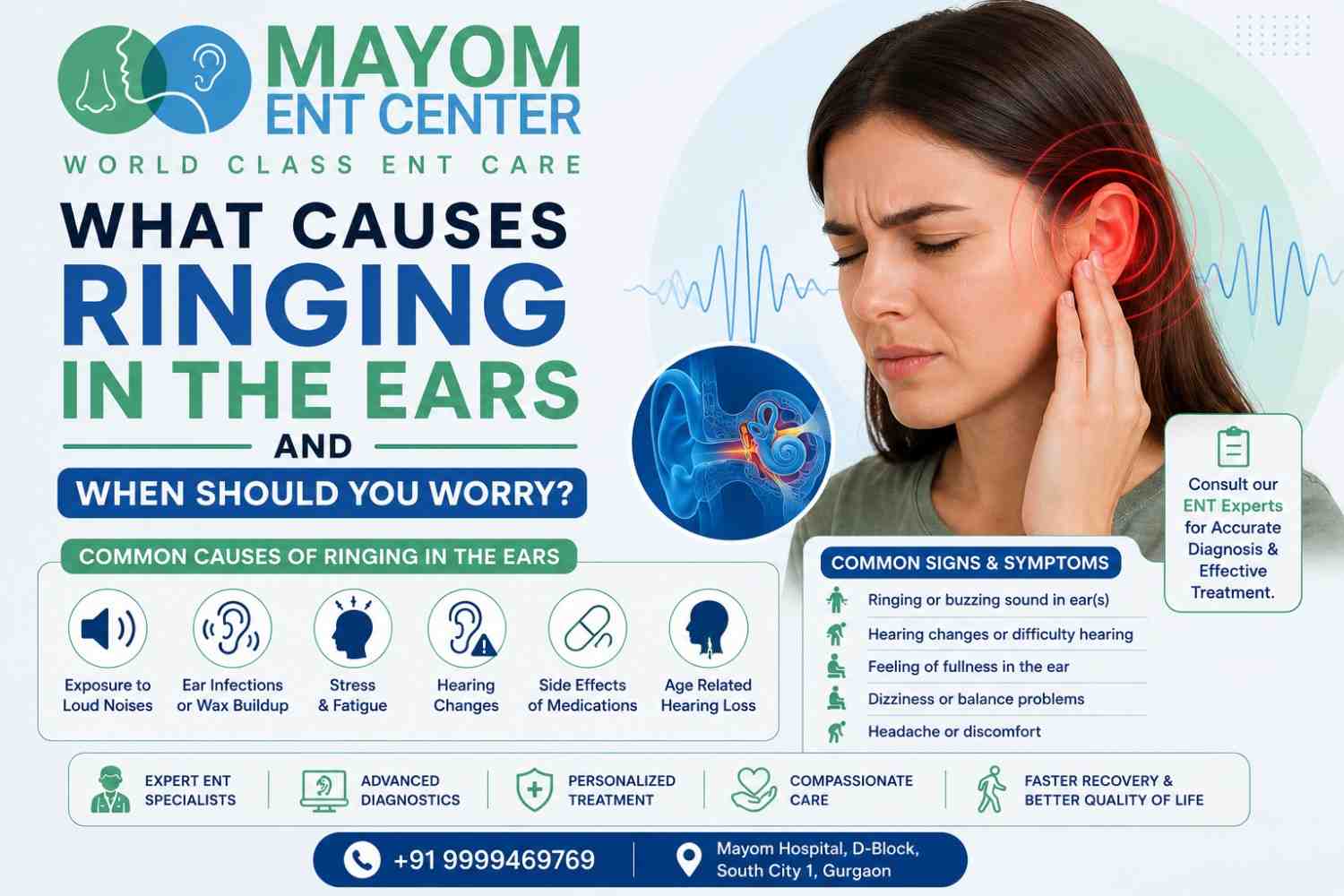
It's annoying.
Relentless.
Sometimes downright unsettling.
You climb into bed after a long day, the room is quiet, the lights are off, and then it starts—a faint whistle. Or maybe it's a buzzing sound. Some people describe it as a distant electrical hum. Others swear it sounds like crickets trapped inside their heads. Whatever form it takes, ringing in the ears has a way of stealing your attention and refusing to give it back.
The medical term for this condition is tinnitus. And despite how common it is, many people don't know what causes it—or when it signals something more serious.
At ENT GURGAON, one of the most frequent questions patients ask Dr Manish Prakash is surprisingly simple: "Should I be worried about this ringing sound?"
The answer isn't always straightforward.
Because tinnitus isn't actually a disease. It's a symptom. A clue. A signal that something else may be happening inside the hearing system.
Sometimes that "something" is harmless.
Sometimes it isn't.
Let's start with the most common culprit.
Here's the strange part.
Many people with hearing loss don't realise they're losing their hearing.
Not at first.
Hearing decline often arrives quietly, creeping in over months or years, like a photograph gradually fading in sunlight. You compensate without noticing. You increase the television volume. You ask people to repeat themselves. You avoid crowded restaurants because conversations suddenly feel exhausting.
Then the ringing begins.
When the brain receives fewer sound signals from damaged hearing cells, it sometimes creates its own internal noise—a bit like a radio searching desperately for a station and producing static in the process.
Which brings us to the real problem.
Ignoring tinnitus can sometimes mean ignoring underlying hearing loss.
That's why specialists offering Hearing loss treatment in Gurgaon often recommend comprehensive hearing evaluations for patients experiencing persistent ringing.
Think about the average day.
Earbuds during the commute.
Headphones at work.
Music while exercising.
Podcasts before sleep.
Our ears barely get a break.
A teenager listening to music at maximum volume for three hours might not notice damage immediately. Neither will the office worker attend loud weddings every weekend. But the tiny hair cells inside the inner ear—delicate structures that cannot regenerate once destroyed—absorb that punishment over time.
And eventually?
The ringing starts.
Sometimes it's temporary after a loud concert.
Sometimes it stays.
Forever.
That's why hearing protection isn't just for factory workers anymore. It's for DJs. Gamers. Gym enthusiasts. Anyone who regularly exposes their ears to high-volume environments.
This surprises people.
A simple earwax blockage can trigger tinnitus.
Not dramatic. Not dangerous. Just frustrating.
Imagine trying to hear through a door that's only half open. The altered sound input can create pressure changes and hearing distortion that lead to ringing sensations.
The good news?
This is often one of the easiest problems for an ENT GURGAON specialist to diagnose and treat.
The bad news?
People frequently make it worse by attacking their ears with cotton buds.
Which, ironically, pushes wax deeper.
Not a great strategy.
Your ears and nose are more connected than most people realise.
Ever noticed your ears popping during a flight?
That's the Eustachian tube at work, regulating pressure between the middle ear and the outside world.
When allergies, sinus infections, or nasal congestion interfere with that process, pressure builds. Hearing changes. Ringing can appear.
Some patients spend months worrying about serious hearing problems when the actual issue is chronic nasal inflammation.
A thorough ENT examination often uncovers these hidden causes.
Stress doesn't necessarily cause tinnitus.
But it can crank the volume up.
A curious thing happens when people become anxious about ringing in their ears—they start listening for it.
Constantly.
The brain, always eager to prioritise perceived threats, places the sound front and centre.
Suddenly, that faint buzz becomes impossible to ignore.
Like noticing a dripping tap in a silent house.
Once you hear it, you can't unhear it.
Many patients report that their tinnitus worsens during periods of work pressure, poor sleep, emotional strain, or burnout.
Coincidence?
Usually not.
This is the question that matters.
Most tinnitus cases aren't medical emergencies.
But some situations deserve immediate attention.
Seek professional evaluation if:
These symptoms can occasionally indicate underlying ear disease, circulation issues, infections, or other conditions requiring prompt treatment.
And time matters.
Particularly when sudden hearing loss is involved.
Patients who seek Hearing loss treatment in Gurgaon quickly often have significantly better outcomes than those who wait weeks, hoping symptoms will disappear.
In many cases, yes.
For patients whose tinnitus is linked to hearing loss, hearing aids often provide substantial relief.
By amplifying environmental sounds, they reduce the brain's need to "fill in the silence" with internal noise.
It's a bit like turning on soft background music in a room where an annoying refrigerator hum suddenly becomes less noticeable.
Simple.
Effective.
This is why consulting a qualified Hearing Aid Specialist in Gurgaon can be an important part of long-term tinnitus management.
Ringing in the ears is incredibly common.
But common doesn't mean you should ignore it.
Sometimes tinnitus is linked to earwax. Sometimes allergies. Sometimes stress. Sometimes age-related hearing decline. Occasionally, it serves as an early warning sign that your hearing needs attention.
The challenge is knowing the difference.
That's where professional evaluation becomes valuable.
At ENT GURGAON, Dr Manish Prakash regularly helps patients identify the true cause behind persistent ringing and develop personalised treatment plans. Whether the solution involves medical therapy, hearing rehabilitation, lifestyle adjustments, or referral to a Hearing Aid Specialist in Gurgaon, early assessment can prevent unnecessary worry and improve quality of life.
Because silence shouldn't feel like a luxury.
And when your ears start sending signals, it's usually worth listening.